
Half the trust's emergency admissions waited over 12 hours in August, the second worst in England. The council's £34m of care cuts skip consultation.
The chair of the NHS trust that runs Warrington Hospital has written to Warrington Borough Council warning that its next round of savings will be felt inside the hospital. Full Council is asked to endorse those savings on Monday 21 September.
The council’s own report settles the scale of it. Phase 2 of its savings programme is worth £51.243m. Of that, £34m comes out of adult social care. None of the £34m is going out to public consultation.
What the council’s papers actually say
The Medium Term Financial Plan Update went to Scrutiny Committee on 7 September and to Cabinet on 9 September. The papers are published in full on the council’s committee system, as Appendix A and its two appendices.
Adult social care carries three of the proposals, all of them in Appendix 2:
- £17.8m from older adults (ref Ph2_1). A targeted review of high cost packages, “reducing new admissions to residential and nursing care”, and more reviewing and auditing of existing care.
- £12.4m from younger adults (ref Ph2_2). The council expects “a reduction in the use of supported accommodation, fewer single tenancies and a proportionate care offer to meet needs”.
- £3.8m from staffing (ref Ph2_3), through “further redundancy schemes” and a review of staff to management ratios. The estimated staffing impact is 70 to 100 full-time equivalent posts.
The money arrives late. The council’s profile is £0.2m in 2026/27, then £7.8m in 2027/28, £10.9m in 2028/29 and £15.1m in 2029/30.
One line in the older adults proposal matters more than the rest to anyone who uses the hospital. The council says the change works on “the entry points to social care from community and hospital”, with people “returning and remaining at home for as long as possible”.
None of the £34m is being consulted on
The report sorts every proposal into one of two appendices. Appendix 1 goes out to public consultation. It is worth £4.701m and covers libraries and community buildings, the cultural services contract, parking charges and environment services. We set those out in our report on the £51.2m savings plan.
Appendix 2 does not go out to consultation. Cabinet approves it, and paragraph 16.3 delegates implementation to the Chief Executive as Head of Paid Service, in consultation with the section 151 officer, the Monitoring Officer and the relevant service director. Paragraph 16.6 says each decision is then recorded in an Officer Decision Notice.
The council’s own summary table for adult social care reads £0 against “Public Consultation” and £34m against “Delegated Authority”.
Paragraph 20.1 lists who was consulted while the proposals were being written: the Strategic Leadership Team, all directorate department management teams, the Ministerial Envoys, MHCLG, CIPFA, the portfolio holder and Cabinet. No health body appears on that list.
The hospital’s numbers
NHS England published August’s A&E figures on 10 September. They are the hardest evidence in this argument, and they are not good.
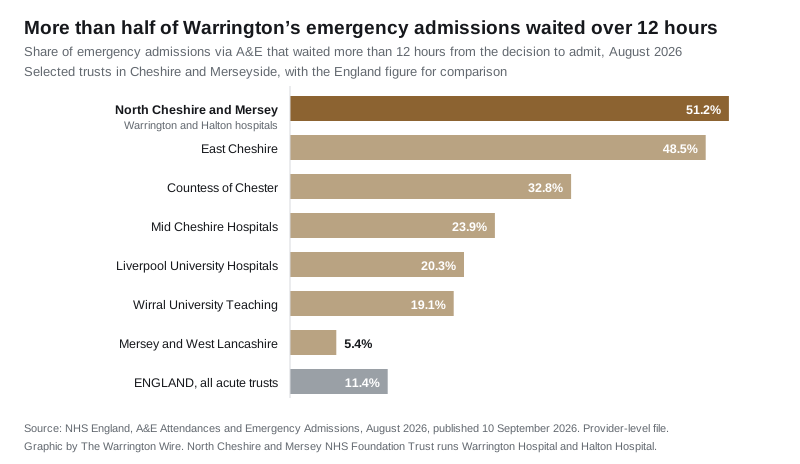
North Cheshire and Mersey NHS Foundation Trust runs Warrington Hospital and Halton Hospital in Runcorn. In August:
- 882 patients waited more than 12 hours between a doctor deciding to admit them and a bed being found.
- There were 1,724 emergency admissions through A&E in the whole month. So 51.2% of them waited more than 12 hours.
- The figure for England was 11.4%.
Only one acute trust in the country did worse. Of the 120 trusts in England running a type 1, consultant-led A&E, Warrington’s was second from the bottom on that measure.
Four-hour performance reads very differently, which is worth saying plainly. Across all of the trust’s urgent care sites there were 12,713 attendances in August and 74.8% were seen within four hours, a shade above the England average of 74.5%. At the main A&E at Warrington Hospital, though, there were 6,714 attendances and 53.2% were seen within four hours. The England figure for type 1 departments was 60.9%.
Why social care turns up in a hospital corridor
The link between the two organisations is a number NHS England publishes every month: patients who no longer meet the criteria to reside in a hospital bed.
On an average day in August, 147 patients at the trust no longer met that criterion. On an average day, 98 of them were still in a bed. The count peaked at 184 on 21 August and fell to its lowest, 108, on 31 August.
Over the month that came to 3,038 delayed bed days, which NHS England costs at £1,707,356.
Set that against the trust’s bed base. In the quarter to June 2026 it had 562 general and acute overnight beds available, running at 94.8% occupancy. The patients who no longer needed to be there came to roughly a quarter of those beds; the ones who actually stayed put came to roughly one in six.
The published reasons for the delays point outwards, at the system, rather than at the wards. For patients already in hospital seven days or more, the single largest reason in August was waiting for referrals to be made by the care transfer hub, at a weekly average of 29.75 patients and £530,484 for the month. Behind it sat residential or nursing home care not yet being available, arrangements for residential or nursing care still being made, and home-based reablement not being available.
What the trust has said in its own words
The trust published its own account of A&E performance on 7 August, reporting that more than 75% of people were seen, discharged or admitted within four hours in June, up from 67% the previous summer.
Its chief executive, Nikhil Khashu, added this: “We know some people still experience longer waits, particularly when they are waiting for a hospital bed to become available. We will continue to focus our efforts on making further improvements, working with partners across health and social care.”
The letter
Andy Carter has chaired the trust since 1 April 2026, having joined as chair designate in January. He was the Conservative MP for Warrington South from 2019 to 2024. The trust announced his appointment in November 2025.
He wrote to the council’s chief executive and its leader before Cabinet met, and the letter describes adult social care as “the single greatest constraint” on the trust’s ability to care for Warrington residents.
We have not seen the letter. The trust has not published it, and it does not appear in the council’s Cabinet papers. What we can check is its arithmetic, and it holds: the £34m, its two thirds share of Phase 2, and the 70 to 100 posts all match the council’s own report, line for line.
The council has not published a response. Its last statement on the savings was on 21 August, when the cabinet member for finance, Cllr Denis Matthews, said the council faces “a £179m gap up to 2029/30” and that “seeking the views of our residents and partners will therefore be an important part of this process”.
What it means for you
If you use adult social care, or care for someone who does. Nothing changes this month. The £34m is spread over four years and only £0.2m of it falls in 2026/27. But the decisions that deliver it will be taken by officers under delegated authority, not at a public meeting, and each one will appear as an Officer Decision Notice rather than as a committee report. Paragraph 16.4 leaves a door open: if a proposal later turns out to need consultation, implementation is deferred until that happens.
If you want to say something before it is signed off. Full Council is asked to endorse the plan on Monday 21 September. Council meetings take public questions and your ward councillor can raise the point for you; the council lists councillors and meeting papers on its committee system.
If you are heading to A&E. The four-hour figures and the 12-hour figures measure different things. The first covers everyone who turns up. The second covers only the people a doctor has decided to admit, and at this trust that is where the problem sits.
The consultations that are happening are the Appendix 1 ones: libraries and community buildings, the cultural services contract, parking charges rising 10% in each of April 2027, 2028 and 2029, and environment services. If parking is your concern, our guide to parking in Warrington sets out the current charges, and council tax bands explains where the council’s money comes from in the first place.
Sources
- Warrington Borough Council, Medium Term Financial Plan Update, report to Cabinet 9 September 2026, with Appendix 1 and Appendix 2, published on the council’s committee system
- NHS England, A&E Attendances and Emergency Admissions, August 2026, provider-level file, published 10 September 2026
- NHS England, Acute discharge situation report, August 2026
- NHS England, Bed availability and occupancy, quarter 1 2026/27
- North Cheshire and Mersey NHS Foundation Trust news, 7 August 2026 and 19 November 2025
- Warrington Borough Council news, 21 August 2026
Have your say