
Car park charges up 10% in April 2027, 2028 and 2029, a new operating model for libraries, and 206 to 237 posts gone. Scrutiny takes it on 7 September.
Warrington Borough Council has published the second wave of its savings plan, and it runs to £51.243m. The report goes to Scrutiny Committee on Monday 7 September and to Cabinet on Wednesday 9 September, before Full Council is asked to endorse it. The report does not name the Full Council date; the next scheduled meeting is 21 September.
Four proposals would be put out to public consultation. Everything else would be signed off by Cabinet and handed to the Chief Executive to implement, with no consultation at all.
The papers are on the council’s committee system as Agenda Item 4, Scrutiny of the Medium Term Financial Plan Update, with the report to Cabinet and two appendices listing every proposal.
The four things residents get consulted on
These are the proposals in Appendix 1, worth £4.701m and about 22 full-time posts. Cabinet is being asked to approve them “in principle”, then start the consultations.
- Parking charges up 10% in each of April 2027, April 2028 and April 2029 (ref Ph2_38), across all council-owned car parks, alongside less frequent cleaning at the Time Square multi-storey. Worth £420,000. The council’s own entry records the risk: loss of custom to private car parks, and an impact on the town and district centre economies.
- A review of community building based services (Ph2_36), aiming to cut the running costs of the library service and community centres by exploring alternative operating models. Worth £2.728m in 2028/29. The council says this “may reduce the number of community buildings directly managed by the council” while aiming to keep a comprehensive spread of services.
- A new cultural services contract with a reduced management fee (Ph2_37), worth £403,000, with cultural venues folded into an assets review.
- A borough-wide review of Environment Services (Ph2_39), worth £1.15m and around 22 posts.
That last one is the one people will notice on the ground. The council’s own list of impacts includes a “considerable impact on the ‘look of the borough’”, fewer Ranger-led activities, statutory management of environmentally sensitive sites only, a review of provision at Birchwood Forest Park and the Trans Pennine Trail, reduced capacity to support events, volunteers and Friends of groups, a review of Public Rights of Way inspections, the transfer of sports facilities, and prioritised fly-tipping removal rather than all of it.
Where the £51.2m comes from
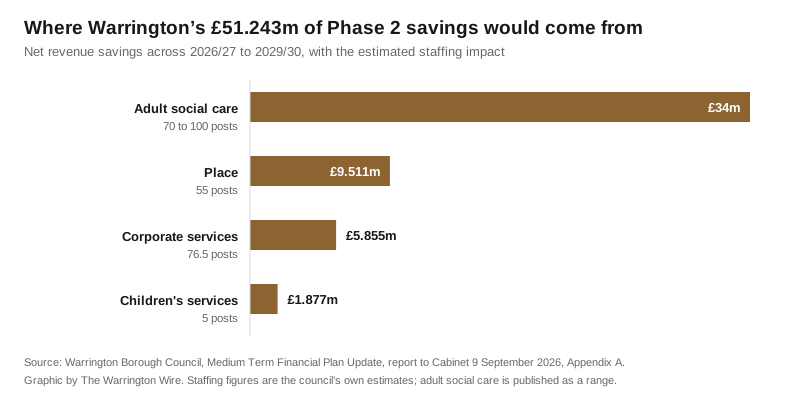
Two thirds of it is adult social care. The report breaks the total down like this:
| Directorate | Phase 2 savings | Estimated posts |
|---|---|---|
| Adult social care | £34m | 70 to 100 |
| Place | £9.511m | 55 |
| Corporate services | £5.855m | 76.5 |
| Children’s services | £1.877m | 5 |
| Total | £51.243m | 206.5 to 236.5 |
Add those staffing figures up and the plan accounts for between roughly 206 and 237 full-time equivalent posts. The report never gives a headline total; the range comes from adding its own per-directorate figures, and the adult social care line is published as a range rather than a number.
The £34m from adult social care sits in three proposals, none of which goes to consultation. Two are about care packages: reviewing high-cost packages, cutting new admissions to residential and nursing care for older adults, and reducing new starts of care, support and accommodation for younger adults. The third is a straight staffing cut of 70 to 100 posts through “further redundancy schemes” and a review of staff to management ratios.
The cuts nobody will be asked about
Appendix 2 holds £46.542m of savings that Cabinet would approve outright, with implementation delegated to the Chief Executive. The report’s own impact column is blunt about several of them:
- Legal services cut 25%, about 10 posts, leaving “reduced ability to bring prosecutions; advise on licensing; attend and provide advice to committees, particularly licensing and planning”.
- IT cut 25%, six posts: “increased chance of disruption to digital services for residents”, no second data centre for resilience, and reduced backups in the event of a cyber attack.
- Contact Warrington down 7.5 posts, with a review of the opening times of 1 Time Square and “less staff initially available to take face to face appointments” or answer the phone.
- Democratic and electoral services down from 12.5 posts to about 7.5, with “changes to committees, new constitution, less meetings”.
- Highways inspection and maintenance reduced, with less carriageway sweeping and weed treatment: the council records “increased risk of 3rd Party claims, worsening road conditions, risk of injury/ damage”.
- Out-of-hours call-outs for traffic signal faults would stop. Faults occurring outside office hours “will not be attended to and rectified until the next day”. Saving: £30,000.
- Security removed from the bus interchange, leaving anti-social behaviour to be dealt with by bus operator staff calling the police.
- Public protection and community safety restructured around high-risk interventions only, about 17 posts.
How Warrington got here
The council’s budget page puts the gap at £178.9m between 2026/27 and 2029/30, and blames inadequate budgeting, the impact of its commercial portfolio and the risk from six years of unaudited accounts. It has applied for Exceptional Financial Support, effectively a government loan repayable over 20 years, and says the government confirmed in principle £87.029m for 2025/26 and £92.047m for 2026/27.
Phase 1, approved by Full Council on 2 March 2026, was £39m. This is Phase 2. Phase 3 comes back to councillors in March 2027. Even with all of Phase 2 delivered, the report says £88.39m of the gap is still to be addressed.
There is also a live overspend. At the end of the first quarter of this financial year the council was forecasting an adverse variance of £20.603m, of which £8.661m is departmental overspending and £11.942m is savings it has not achieved.
Cabinet is also being asked to put up to £5m more into the Transformation Fund, taken from service reserves, to pay for the cost of change including redundancies. That would leave service reserves at £7.746m. The report argues the return is exceptional: up to £5.75m spent to deliver £90.517m of recurring savings.
Councillor Denis Matthews, cabinet member for finance, said when the total was announced on 21 August that the council “faces a significant financial challenge” and that “we know that we are faced with difficult decisions”.
What it means for you
If you park in a council car park, the proposal is a 10% rise three years running from April 2027. Compounded, that is about a third more than today’s price by April 2029, and it is one of the four items you will actually get a say on. Our Warrington parking page has the current charges.
If you use a library or a community centre, the proposal does not name a building and does not close one. It commits to “exploring alternative operating models”, which in other councils has meant community-run or volunteer-run libraries. The saving is not booked until 2028/29, so there is time, and it is on the consultation list.
If you report fly-tipping, a pothole or a broken traffic signal, expect slower answers. Fly-tipping removal becomes prioritised rather than automatic, highway inspections and sweeping reduce, and traffic signal faults after office hours would wait until the next working day.
The consultations have not opened yet. Cabinet is being asked on 9 September to approve their commencement, so the earliest you can respond is after that meeting. Before then, Scrutiny Committee takes the report at 6pm on Monday 7 September at 1 Time Square, and its agenda and papers are public. If you want to raise something with a councillor first, the council’s committee system will tell you who yours is.
We will report what the consultations cover, and how to respond to them, when they open.
Have your say