
Warrington must plan for 1,067 homes a year from December 2028, up 28%. The Local Plan update, Fiddlers Ferry's 860 homes, and where the last 3,411 went.
Warrington’s adopted Local Plan asks for 816 new homes a year. From December 2028 the government will require the borough to plan for 1,067 a year, a 28% increase, and the council has already started rewriting the plan to find the land.
That single change is the whole of Warrington planning policy for the next two years. The council said so itself, in paragraph 2.3 of the Scoping Consultation Document it published in April 2026. Everything below comes from the council’s own documents.
The numbers, and how far ahead delivery is running
The Warrington Local Plan 2021/22 to 2038/39 was adopted at full council on 4 December 2023, replacing the 2014 Core Strategy in its entirety. It commits the borough to a minimum of 14,688 new homes over eighteen years, an average of 816 a year, delivered on a stepped basis: 678 a year for the first five years, then 870 a year for the remaining thirteen.
Delivery has beaten that. In the first four years from 1 April 2021 the borough completed 3,411 new homes, including 838 affordable ones, which the council describes as exceeding the requirement to this point. The vast majority were built inside the existing urban area rather than on green field allocations, and that is the fact that matters most for what happens next: the easy brownfield capacity is being used up.
On the employment side, the plan needs 168 hectares across the period and 62.45 hectares have come forward so far.
Why the target is going up
The government has introduced a new mandatory method for calculating minimum housing need, based on a proportional increase to existing housing stock with an extra uplift where homes are least affordable. Warrington’s share of that comes out at 1,067 homes a year.
The current plan’s numbers stay valid until December 2028, when key elements of it turn five years old and fall out of date. That deadline is what is driving everything.
The other national change that matters here is Green Belt policy. The government now treats a shortage of homes or business space as a valid reason to alter Green Belt boundaries through a Local Plan, and has created a new Grey Belt category: Green Belt land that is either previously developed or does not strongly serve the purposes of stopping sprawl, keeping towns apart or protecting historic towns. Grey Belt has to be looked at first if land has to be released.
Warrington’s own view is blunt. The council says the land already allocated may no longer be enough, that brownfield must come first, and that “there may be a need for additional land, and further release of Green Belt land may need to be considered”. It also flags Grey Belt as a risk of “scattered or unplanned development” that undermines its strategy. A comprehensive Green Belt Assessment update is under way, funded by government, and will identify any Grey Belt in the borough.
Where the new Local Plan has got to
- 16 April 2026: the council formally gave notice of an update to the Local Plan under the Town and Country Planning (Local Planning) (England) Regulations 2026. The new plan will be called The Warrington Local Plan and will absorb the borough’s minerals and waste plan.
- 16 April to 1 June 2026: scoping consultation and call for sites. More than 300 responses came in from residents, parish councils, community groups, businesses, landowners and developers.
- By 7 September 2026: the council expects to pass Gateway 1 and formally start the 30-month preparation process. The plan will be mostly digital, focused on site allocations and local spatial policies, with general policies handed over to national decision-making policy.
- Autumn or winter 2026: first formal consultation, on the vision, aims, objectives and proposed spatial strategy.
- Autumn or winter 2027: second consultation, on the full draft plan, before it goes to an independent inspector.
One consequence is already visible on the ground. The council notes that developers have started running their own consultations across the borough in response to the higher five-year land supply bar, which is separate from anything the council does and separate from any later planning application.
Fiddlers Ferry
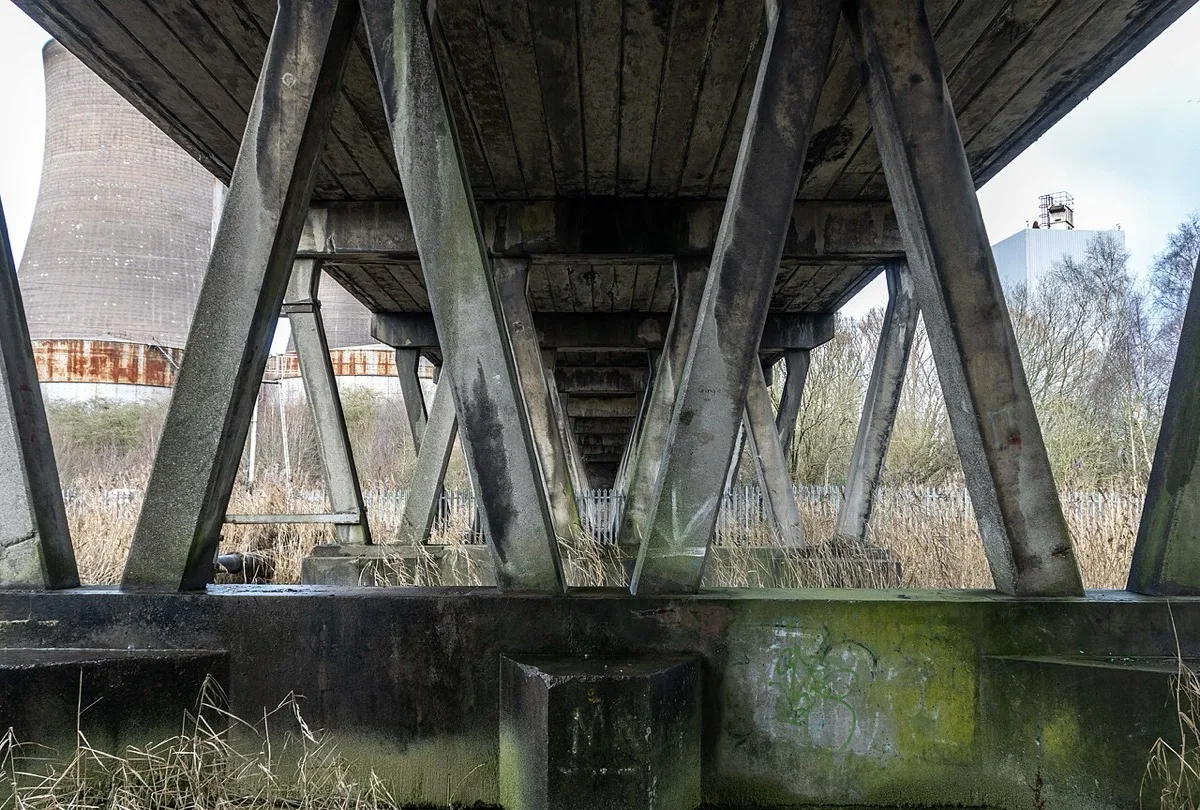
The former power station at Cuerdley is the borough’s biggest single allocation. Policy MD3 of the adopted plan sets it aside for 860 homes and 101 hectares of employment land across the plan period, and requires a comprehensive site-wide development framework before the detail is settled.
That framework, prepared by landowner Peel NRE with council officers, was agreed at cabinet on 9 September 2024 and is now a material consideration for planning applications anywhere on the allocated site. Peel describes the wider site as 820 acres delivered through a ten to fifteen year mixed-use masterplan, with a local centre, a school, parkland, restored lagoons and a green link between Sankey Valley Park and Spike Island.
Fiddlers Ferry matters beyond its own boundary. The council states that employment land availability across Warrington is running low and that Fiddlers Ferry is the only site in the borough with significant development capacity left. That is why the new plan has to find more, including for the uses the revised national policy names specifically: laboratories, gigafactories, data centres, digital infrastructure, freight and logistics.
South East Warrington, and the smaller allocations
The other main development area, the South East Warrington Urban Extension under Policy MD2, has been through three rounds of consultation on its own development framework, and the council anticipates approving it later in 2026. Both MD2 and MD3 are moving, in the council’s words, “albeit not as quickly as originally envisaged”.
The smaller outlying settlement allocations under Policies OS1 to OS6 are further along: all now have planning consent, and are either discharging conditions or in early site preparation. Sixteen new gypsy and traveller pitches have also been provided since the plan period began.
Looking up an application
Warrington is a unitary authority, so it decides its own planning applications with no district or county layer above it. The register is not on the Idox system most Cheshire and Greater Manchester councils use; it is a bespoke application at online.warrington.gov.uk/planning, which needs a browser rather than a link you can bookmark to a weekly list.
The council’s planning policy pages carry the adopted plan, the policies map and the Local Plan update documents, including the full Scoping Consultation Document quoted throughout this page.
More Warrington local information: house prices, trains to London, roadworks and travel and things to do in Warrington.
Have your say