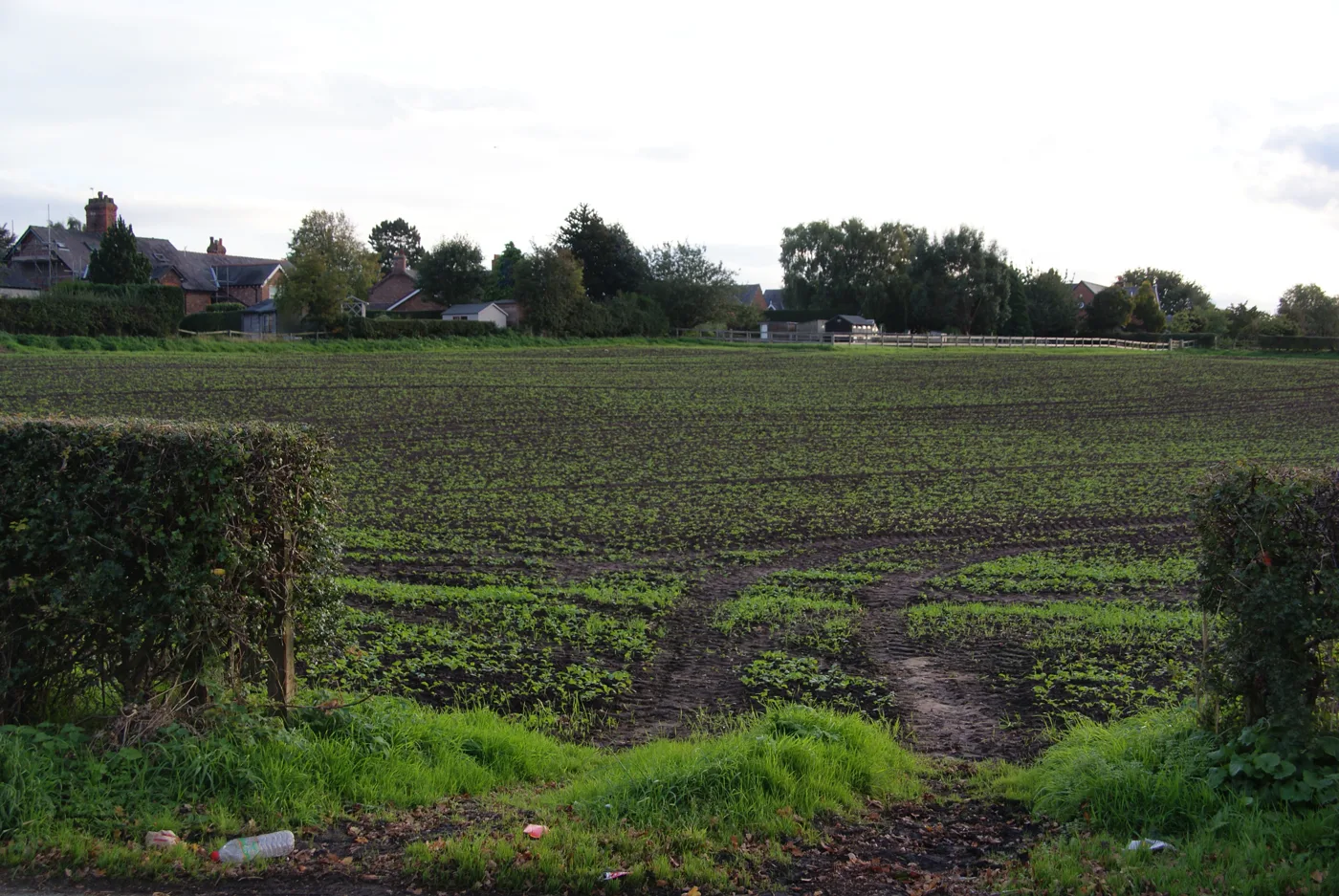

Cabinet votes Wednesday on the blueprint for 4,200 homes south of Grappenhall and Appleton: six neighbourhoods, four schools, no building before 2029.
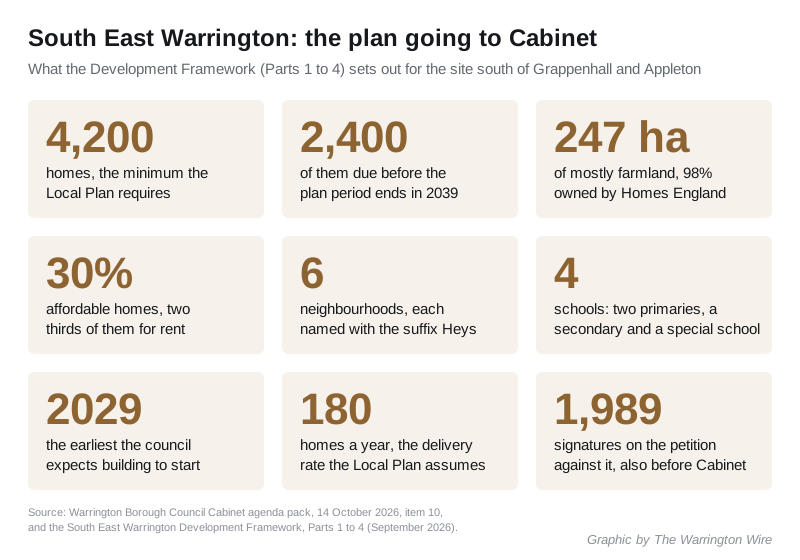
The blueprint for Warrington’s biggest housing site in a generation goes to the council’s Cabinet on Wednesday 14 October. It covers at least 4,200 homes on 247 hectares of farmland between Grappenhall, Appleton Thorn and the M56.
Officers are recommending approval. If Cabinet agrees, the document becomes a material consideration for every planning application on the land. The report says construction will not start before 2029 at the earliest. (Cabinet agenda pack, 14 October 2026, item 10)
What is being decided
The land is allocated in the council’s Local Plan under Policy MD2 as the South East Warrington Urban Extension. The policy says a Development Framework has to be agreed before any planning application can be submitted.
Homes England, which owns 98% of the developable land, has written that framework in five parts. Cabinet is asked to approve Parts 1 to 4. Part 5, the infrastructure delivery plan with the phasing and the trigger points for roads and schools, comes later.
The site runs from Stockton Lane in Grappenhall south to the M56 and east around the existing Grappenhall Heys estate. It has been in public ownership since the 1970s, when it was part of Warrington New Town. A private owner holds the remaining 2%, near Stretton.
Six neighbourhoods, all called Heys
The framework divides the site into six neighbourhoods. Each takes the suffix “Heys”, which the document explains as an Anglo-Saxon word for enclosed or hedged land, matching the existing Grappenhall Heys.
- Stockton Heys: between Lumb Brook Road and Grappenhall, south of Stockton Lane and north of Parrs Wood. The special school is planned here.
- Lumb Brook Heys: west of Grappenhall Heys Walled Garden, around Witherwin Avenue and Lumb Brook Road.
- Green Heys: near Lumb Brook Road and Wright’s Green, on a new link road from Dipping Brook Avenue to Grappenhall Heys. The secondary school, leisure centre and main local services sit here.
- Broad Heys: south of Grappenhall, between Broad Lane and Grappenhall Heys woods.
- Pewterspear Heys: between Stretton Road, Blackcap Road, Dipping Brook Avenue and the existing Pewterspear Green.
- Stretton Heys: the south-western corner, either side of a new link road from the A49 to the B5356 Stretton Road.
What comes with the homes
Policy MD2 and the framework commit the development to:
- at least 30% affordable housing, with two thirds of that for rent
- two two-form-entry primary schools, each able to grow to three forms
- a four-form-entry secondary school
- a 56-place special school, or a third primary school if that is not delivered
- a leisure centre with health facilities, plus a contribution to expanding the proposed Appleton Cross GP surgery
- three public parks: Lumb Brook Park, Green Heys Park and Pewterspear Park, which the framework compares in size to Alexandra Park in Stockton Heath, Dudlow’s Green Park in Appleton and Bank Park
- a community recycling centre, local shops and playing pitches
- a package of road, bus, walking and cycling improvements on and off the site
Density is set at a minimum of 35 homes per hectare across the site. The Local Plan assumes an average of 180 new homes a year once building starts, with 2,400 of the 4,200 due before the plan period ends in 2039.
The petition and the objections
A petition of 1,989 signatures against the whole scheme was handed to the council on 2 November 2024. Because it passed 1,500 names, the council’s petition scheme sends it to Cabinet alongside the framework. Cabinet can refer it to Full Council for debate if it chooses.
Officers say the petition should not stop approval. Their reasoning is that the principle of building here was settled when the Local Plan was adopted in December 2023, after public consultation and an examination by independent inspectors.
Homes England ran three rounds of public engagement before writing the framework:
- Phase 1, 30 August to 14 October 2024: 450 people at drop-in events, 237 people gave 857 pieces of feedback
- Phase 2, 10 March to 6 April 2025: 192 people made 862 contributions
- Phase 3, 3 November to 15 December 2025: 256 people at four drop-ins, more than 2,293 contributions from over 300 people
The report lists the most common objections as the loss of Green Belt and farmland, scepticism about the need for the homes, congestion on local roads and at the canal crossings, and demands that a new hospital, canal bridges, schools and GP capacity be built before the first house.
A working group of seven parish councils, Stretton, Appleton, Grappenhall and Thelwall, Stockton Heath, Hatton, Walton and Lymm, met Homes England through 2025.
The ancient woodland question
The Woodland Trust wrote to councillors on 27 August 2026 asking for a 50 metre buffer between new homes and the ancient woodland at The Dingle and Fords Rough in the Lumb Brook valley, on the site’s western edge.
The framework sets a minimum of 30 metres. Officers point out that the standing advice from Natural England and the Forestry Commission asks for 15 metres, and say a wider buffer can still be required if surveys at the planning stage show it is needed.
A Habitats Regulations Assessment found the plan could affect Manchester Mosses, Rixton Clay Pits and the Mersey Estuary through water pollution, traffic emissions and more visitors. It concluded there would be no harm if the mitigation in the framework is applied, and Natural England agreed.
What happens next
If Cabinet approves Parts 1 to 4:
- Homes England runs a public procurement to appoint a private “master developer” and set up a lead delivery organisation with it.
- That organisation writes Part 5, the infrastructure delivery plan, with another round of public engagement.
- A comprehensive planning application goes to the council’s Development Management Committee.
- Building starts no earlier than 2029, subject to planning conditions being discharged.
Homes England has paid for the framework and funds the council officers’ time on it through a planning performance agreement.
What it means for you
If you live in Grappenhall, Appleton, Stretton or Stockton Heath, this is the document that fixes where the roads, schools and parks go. The detailed layouts, the phasing and the trigger points for infrastructure are still to come in Part 5 and in the planning application. Those are the stages at which formal objections can be lodged.
If you want to watch the decision, Cabinet meets at 5pm on Wednesday 14 October in rooms 15 to 17 at 1 Time Square, WA1 2NT. The meeting is open to the public. The deadline to table a public question has passed, as questions must be in seven clear working days ahead.
If you are waiting for a home, nothing is built for at least three years. The affordable split in the framework is 67% rented, 25% First Homes sold at a 40% discount, and 8% shared ownership.
The three engagement reports and the transport approach are on Homes England’s South East Warrington consultation site. The council’s screening statements are on its development frameworks page. Our running summary of the borough’s housing sites is on Warrington planning news, and the latest sale prices are on Warrington house prices.
Have your say