
Cabinet is asked on 14 October to consult on income-banded council tax support from April 2027, with the top award rising from 78% to 86.5% of the bill.
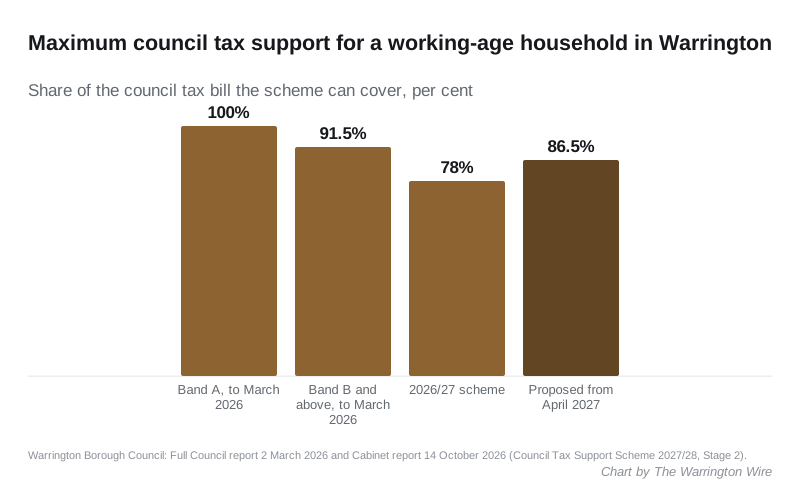
Warrington’s working-age council tax support scheme would be rebuilt around income bands from 1 April 2027, with the maximum award rising from 78% to 86.5% of the bill, under proposals going to the council’s Cabinet on Wednesday 14 October.
Cabinet is asked only for permission to consult. The public consultation is timetabled to open the next day, 15 October, and the final decision rests with Full Council on 1 March 2027. (Cabinet agenda pack, 14 October 2026, item 9)
Where the scheme stands now
Council tax support replaced council tax benefit in 2013. Pensioners’ support is set nationally and cannot be changed by the council. Working-age support is a local scheme, and it is that scheme the council is changing.
Warrington cut it in April this year. Until March 2026 a working-age household in Band A could get 100% of its bill covered, and 91.5% in Band B or above. From 1 April 2026 everyone of working age pays at least 22%, so the maximum award is 78%, and the savings limit fell from £16,000 to £6,000.
The report gives the scale. At December 2025 the scheme cost about £14.6 million a year and supported around 11,700 households. The April changes affected roughly 6,978 working-age claimants. They were designed to cut the gross cost by about £900,000, which the council expects to become a net saving of £600,000 once an extra £300,000 a year of collection and recovery costs is counted.
What phase two would change
The April cuts kept the old means test, which recalculates support every time a Universal Credit award moves. The report says that produces repeated revised bills and new instalment plans, and makes the scheme hard for claimants to understand or check.
The proposal for 2027 is a banded scheme. Weekly net income would be grouped into bands, varied by household size, and each band would carry a fixed percentage discount. Support would only change when income crosses a band threshold.
The design principles going out to consultation are:
- maximum support rises from 78% to 86.5%
- the £6,000 savings limit stays, with no assumed income from savings below it
- a £50 a week earnings disregard, replacing the current standard and additional disregards
- a further £50 a week disregard where the claimant, partner or a dependent child is disabled
- Disability Living Allowance, Personal Independence Payment, Carer’s Allowance, Child Benefit, child maintenance and war pensions all disregarded
- the housing, limited capability for work, carer and disabled child elements of Universal Credit disregarded
- a standard £5 deduction for each non-dependant adult in the home, with the current exceptions kept
- extended payments removed, because the earnings disregard is meant to carry people into work instead
- Universal Credit data from the DWP used to cut the evidence claimants have to send in
The report says the scheme must stay inside the financial envelope set in April, so the lower bands will be set by modelling. It does not yet say where the band thresholds fall or how many households would gain or lose. That modelling, and an equality impact assessment, are promised with the consultation.
Exceptional hardship payments would continue for households in serious difficulty, assessed case by case.
The timetable
| Step | Date |
|---|---|
| Cabinet asked for permission to consult | 14 October 2026 |
| Consultation opens, including with the police and fire authorities | 15 October 2026 |
| Analysis, updated modelling and final equality assessment | 27 November 2026 |
| Cabinet considers the final proposal | 11 January 2027 |
| Full Council decision | 1 March 2027 |
| New scheme starts | 1 April 2027 |
The council’s legal deadline to adopt a 2027/28 scheme is 11 March 2027.
What it means for you
If you are of pension age, nothing changes. Your support is set by national rules.
If you are working age and on council tax support now, the headline change is in your favour: the top award goes up from 78% to 86.5%. Whether you gain or lose overall depends on where your income lands in the bands, which the council has not yet published. The consultation is the moment to ask.
If you work part-time, the flat £50 a week earnings disregard and the end of extended payments are the parts to check against your own payslip.
If you want to respond, the consultation is due to open on 15 October on the council’s consultations page. The council’s current scheme is explained on its council tax support page.
The change comes on top of a 7.48% council tax rise in April, which the government allowed above the usual 5% cap as part of the council’s financial rescue. Band charges by parish are on Warrington council tax bands.
Have your say