
Warrington's GCSE pass rate hit 69.9% at grade 4 and above, six points clear of the North West. The figures, the caveat, and the 24 September remark deadline.
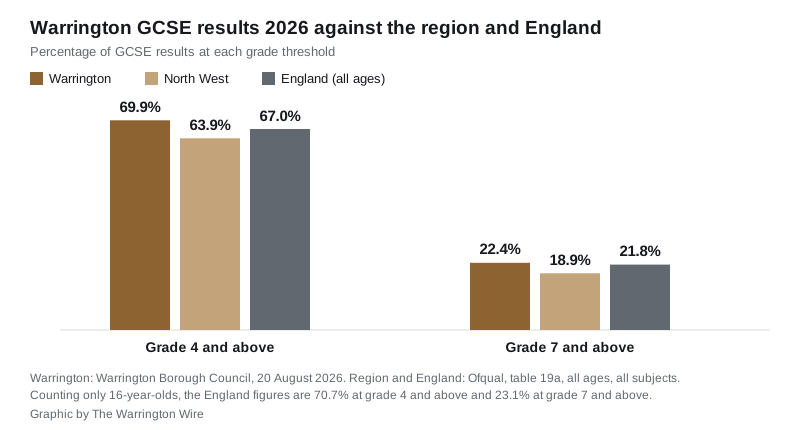
Warrington’s GCSE results came in above the national average again this year. Year 11 students collected their grades on Thursday 20 August. The borough recorded 69.9% of entries at grade 4 and above and 22.4% at grade 7 and above, according to Warrington Borough Council. (Warrington Borough Council)
The council set both figures against England: 67.0% at grade 4 and above, and 21.8% at grade 7 and above. It did not mention the comparison that flatters Warrington most.
The gap the council did not mention
Ofqual published its national statistics the same morning. Across the North West, 63.9% of GCSE results were at grade 4 and above and 18.9% at grade 7 and above. (Ofqual, table 19a)
So Warrington sits six full percentage points above its own region at grade 4 and above, and 3.5 points above it at grade 7 and above. That is a wider gap than the one against England.
The regional picture is the reason. The North West recorded the second-lowest grade 4 pass rate of any English region this summer, ahead only of the West Midlands on 62.4%. London led on 71.7%. The North West also slipped slightly, from 64.2% in 2025.
One caution before anyone frames the number
The council does not say what its figure counts. That matters more than it sounds.
Ofqual publishes two versions of the same national statistic:
- All ages, all entries. England 67.0% at grade 4 and above, 21.8% at grade 7 and above. This is the pair of numbers the council quoted.
- 16-year-olds only. England 70.7% at grade 4 and above, 23.1% at grade 7 and above.
The second set is higher because it strips out resits taken by older students, most of them in English and maths. If Warrington’s 69.9% covers only Year 11 pupils in the borough’s schools, then the honest England comparison is 70.7%, and the borough is marginally below it rather than clearly above.
The council’s statement gives no student numbers, no year-on-year figure and no note on the basis, so the answer is not on the page. It says only that the pass rate “has increased in 2026”.
Where you sit your exams shapes the headline
Ofqual also breaks the results down by type of school or college, and the spread is enormous. For 2026, across England:
- grammar schools: 97.4% at grade 4 and above
- independent and private schools: 88.4%
- local authority maintained comprehensives: 68.6%
- academies: 68.2%
- secondary modern schools: 64.9%
- sixth form colleges: 32.2%
- further education establishments: 17.6%
The bottom two are not failing institutions. They are where students retake GCSE English and maths after Year 11, so almost every entry is a second or third attempt. Read as a league table, that row misleads.
The same trap applies to any borough ranking. Ofqual now publishes an area-by-area map, but it assigns each result using the postcode of the exam centre from the National Centre Number register, not where the student lives. A district with a large selective or independent school scores well on other people’s children.
What Warrington’s schools published
Most schools mark results day with a celebration post and no numbers. One borough school published figures.
Lymm High School reported that 71% of its students gained grades 9 to 5 in both English and maths, and that over 36% of all grades were 7 or above. Headteacher Gwyn Williams said the school had “maintained the remarkable level of consistency we have seen over the past few years”. (Lymm High School)
Those measures are not comparable with the borough’s. Lymm’s 71% counts students who cleared a threshold in two specific subjects. Warrington’s 69.9% counts individual grades across every subject. A school and a council can both be accurate and still be describing different things.
Culcheth High School published a results-day statement praising its Year 11 cohort but no figures. (Culcheth High School) Great Sankey High School and Penketh High School still show 2025 data on their results pages.
No progress measure this year, or last
One familiar number will not appear at all when the official tables are published. Progress 8, which tracks how far pupils move between the end of primary school and their GCSEs, cannot be calculated for this cohort.
As Great Sankey High School puts it on its own results page, there is “no KS2 assessment data available to calculate the baseline for Progress 8” for 2024/25 and 2025/26. These year groups sat no Key Stage 2 tests, because those were cancelled during the pandemic. (Great Sankey High School)
Attainment 8 and the English Baccalaureate measures are unaffected.
What it means for you
If a grade looks wrong, both post-results services close on Thursday 24 September 2026. A clerical re-check is returned within 10 calendar days and a review of marking within 20. The priority review of marking that closed on 20 August covered A-level, AS and Level 3 vocational qualifications only, so it never applied to GCSE. Requests go through the school’s exams officer, and they need written consent from the student. There is no grade protection: a grade can go down as well as up. (JCQ)
If English or maths came in below grade 4, resits run in November. The Pearson Edexcel timetable sets English Language papers on Tuesday 3 and Thursday 5 November, and maths papers on Wednesday 4, Friday 6 and Monday 9 November, all in the morning. (Pearson)
Continuing to study them is a funding condition, not a choice. Under the government’s 16 to 19 maths and English condition of funding for 2026/27, a student holding a GCSE grade 3 must study towards a GCSE. A student with grade 2 or below may study towards either a GCSE or a Functional Skills level 2 qualification. (Department for Education)
Entries go through the school or college, so speak to the exams officer rather than the awarding body.
Sources
- Warrington Borough Council: Warrington students celebrate strong GCSE results, 20 August 2026
- Ofqual: Qualification results in England, summer 2026, data tables 19a, 19b and 20
- Lymm High School exam results
- Culcheth High School GCSE results overview 2026
- Great Sankey High School results
- JCQ post-results services, summer 2026
- Pearson Edexcel November 2026 GCSE timetable
- Department for Education: 16 to 19 maths and English condition of funding
Warrington’s A-level results, published on 13 August, are covered separately in our report on the borough’s post-16 figures.
Have your say