
Warrington's preliminary A-level results: 98.7% passed, but the 22.7% at A* or A trails the North West's 26.5%. The figures, the colleges and the remark deadlines.
Almost every A-level entry in Warrington passed this year, and the borough’s share of top grades did not move. Preliminary figures published by Warrington Borough Council on results day, 13 August, put the overall pass rate at grades A* to E at 98.7%, and the share of entries at A* or A at 22.7%, in line with 2025. The share at A* to B rose 2.4 percentage points to 53.5%, and A* to C held at 77.7%. The council describes the data as preliminary and subject to change. (Warrington Borough Council)
The council said the pass rate remains above the North West and England averages. That is the measure it leads with, and on the measure it does not mention, the borough sits the other way round.
How Warrington compares
Ofqual published its national statistics the same morning. Across the North West, 26.5% of A-level results were at grade A or above and 78.4% at C or above. Across all state-funded schools and colleges in England, the figures were 25.4% and 76.8%. (Ofqual)
So Warrington’s C-and-above share of 77.7% sits between the two, just under the region and a little above the England state-funded figure, while its top-grade share of 22.7% is below both, by 3.8 points against the North West and 2.7 against state-funded England.
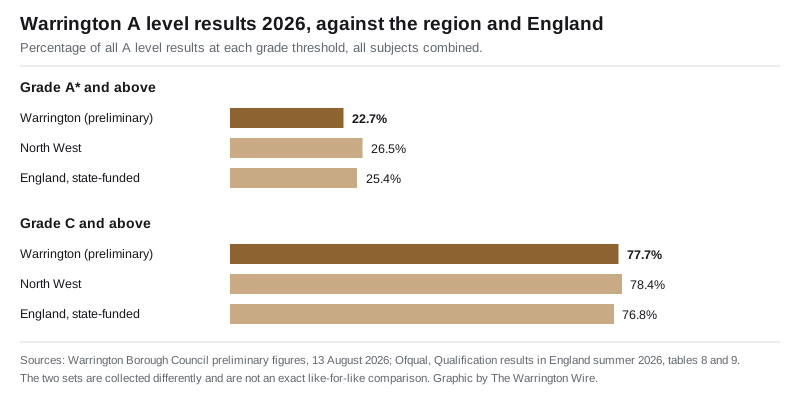
Two cautions before anyone reads too much into the gap. The council’s numbers are preliminary and locally collected. Ofqual’s regional figure covers every centre in the North West, including independent schools, where 48.6% of results were at A or above, and grammar schools, at 43.4%. Where a student sits their exams shapes the headline more than almost anything else: further education establishments nationally recorded 12.8% at A or above and sixth form colleges 25.6%, against 23.5% at academies and 23.0% at local-authority maintained comprehensives.
That is worth holding on to whenever a borough league table appears. Ofqual now publishes an area-by-area map, but it assigns results using the postcode of the exam centre from the National Centre Number register, not where a student lives. A district with a large selective or independent school ranks high on other people’s children.
What the colleges reported
Warrington & Vale Royal College called it its best results day yet. The college reported a 99% pass rate on Level 3 Extended Diplomas, which are equivalent to three A-levels, and a 96% pass rate on T Level programmes, which it said was 3.4 percentage points above the national average. It reported 90% of students achieving high grades and a 3% rise in the number gaining Merit, Distinction and Distinction* grades, broadly equivalent to B, A and A* at A-level. (Warrington & Vale Royal College)
Lymm High School reported another strong set of post-16 results without publishing figures. Its head, Mr Williams, said post-16 qualifications are demanding and that achieving strong results requires real determination. (Lymm High School)
Nationally, 835,950 A-level results were issued on 13 August to 320,505 students across 2,835 schools and colleges, along with 48,835 AS results. Vocational and technical qualifications at level 3 accounted for a further 221,095 passes issued between 1 March and 31 August, and 19,860 students received results for the technical qualification within a T Level.
What it means for you
If a grade is not what a student expected, the appeal route runs on dates that are already close.
- Priority review of marking closes on 20 August. It covers A-level, T Level and level 3 vocational and technical qualifications only, and exam boards complete it within 15 calendar days.
- A standard review of marking and a clerical re-check both close on 24 September, completed within 20 and 10 calendar days respectively. The clerical re-check simply confirms the marks were added and recorded correctly. (JCQ)
- The request goes through the school or college’s exams officer, not the student and not a parent, and written consent from the student is needed first.
- A grade can go down. Boards are required to tell candidates before consent is given that marks and subject grades can fall as well as rise. That is the single most common surprise on results day, and it is the reason consent is asked for in writing.
GCSE results follow on 20 August, and Ofqual will update the same release with level 1 and level 2 outcomes that day. We will publish the Warrington GCSE figures when the council releases them.
Have your say