
Warrington Borough Council plans a 4.98% council tax rise in April and will ask the government for £130.3m of emergency support over two years, as its four-year budget gap reaches £200.9m.
Warrington Borough Council plans to raise its council tax by 4.98% from April 2027. It will also ask the government for £130.3m of emergency support over the next two years.
Both proposals are in the council’s draft budget plan for 2027 to 2031. The Scrutiny Committee papers for 30 November published the plan this week. Cabinet considers it on 2 December.
The plan puts the gap between what the council expects to spend and the money it expects to receive at £200.9m over the four years to 2030/31. That is £22m more than the £178.9m gap reported in the previous plan.
Overview
- Council tax: a proposed 4.98% rise for 2027/28. On the council’s own Band D charge of £2,007.50 this year, that is about £100 a year more.
- Budget gap: £200.9m over four years before savings, £160.5m in 2027/28 alone.
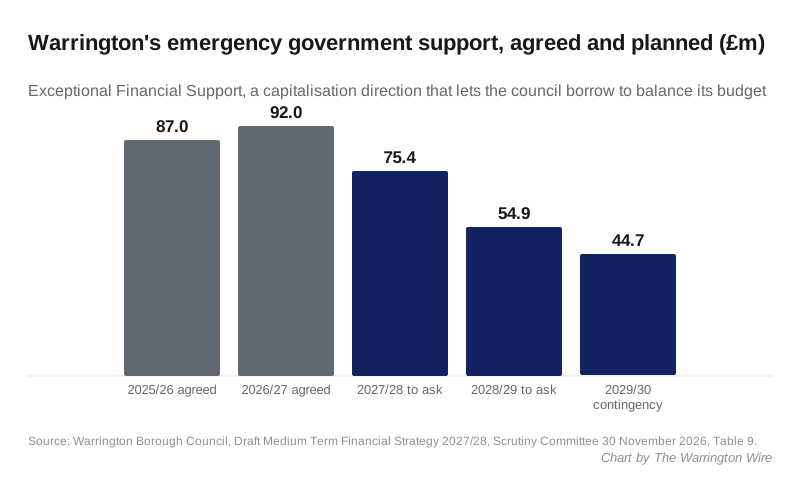
- Emergency support: a request for £75.4m in 2027/28 and £54.9m in 2028/29, plus £44.7m held as a contingency for 2029/30.
- If the government says no: the council’s finance director would have to issue a section 114 notice, the formal warning that a council cannot balance its budget.
- Decision: Cabinet on 2 December, full council on 1 March 2027.
Why the gap has grown
The report says the biggest pressures are rising numbers and more complex needs in adult social care and children’s services. It also says inflation forecasts have been revised up.
New pressures and growth add £50.1m by 2030/31, according to the report. Savings planned for earlier years that have slipped add a further £10.1m.
Rolling the plan forward a year also adds 2030/31, a year in which, the report says, pressures “far outstrip the Council’s ability to raise funding from Council Tax and allocated Government Funding”.
How the council plans to close it
The plan relies on four steps:
- Savings already agreed: £72m by 2029/30, from the budget council in March and Cabinet in September.
- Selling commercial investments and restructuring debt: a target of £60m a year from 2027/28. The report warns this has to be “fully delivered by March 2029” and carries “significant risks regarding values and timing”.
- Savings not yet found: a further £68.9m over the four years. Of that, £29m is the rest of the “phase 3” target and £39.9m is a new “phase 4” with no specific proposals yet.
- Emergency borrowing: the Exceptional Financial Support request.
After the agreed savings and the £60m target, the report says the council would still be £75.4m short in 2027/28 and £54.9m short in 2028/29. That is the amount it will ask the government to cover.
What emergency support costs
Exceptional Financial Support is not a grant. It is permission from the government to treat day-to-day spending as borrowing, paid back over 20 years.
The report puts the yearly cost at about 10% of the amount borrowed: 5% repayment and 5% interest. The £75.4m for 2027/28 would add £7.5m a year to the council’s costs from the following year.
This would be the third and fourth years running that Warrington has relied on it. The government agreed £87.0m for 2025/26 and £92.0m for 2026/27. The report says the bids for later years were not confirmed at the time.
The council does not expect to hear whether it has the support until the final local government finance settlement in late February 2027. If the money is not granted and the budget cannot be balanced, the report says a section 114 notice “may” need to go to full council on 1 March.
What it means for you
The proposed 4.98% is the council’s own share of the bill. Police and fire precepts, and any parish charge, are set separately. Together they bring a Band D bill to between £2,403.04 and £2,525.87 this year, depending on the parish, as our page on Warrington council tax bands shows.
This year’s rise was 7.48%, above the usual 5% limit, with the government’s permission as part of the support deal. The new plan stays just under 5%, so no referendum or special permission would be needed.
The report says each 1% on council tax raises about £1.6m. It also notes that Warrington’s council tax, the 7th highest of 16 similar councils this year, has been kept low as a policy since 1998, and calls that “no longer a sustainable policy”.
The figures are a draft. The report says they will be “further refined” before the final budget goes to full council on 1 March 2027. The provisional government funding settlement is expected in the week of 15 December 2026.
You can watch the Scrutiny Committee at 6pm on Monday 30 November at 1 Time Square, or Cabinet at 5pm on Wednesday 2 December. Both meetings are open to the public.
Have your say