

Warrington will fine landlords from £35,000 for unlawful eviction and £6,000 for refusing a tenant on benefits. The council announced it without the figures.
A Warrington landlord who illegally evicts a tenant now faces a council fine starting at £35,000, with a maximum of £40,000 and no court case needed.
That figure is in a penalty schedule Warrington Borough Council took to Cabinet on 9 September. The council announced the new policies on 16 September without publishing a single one of the amounts.
We read the report. Here is what it actually says.
What the council will charge
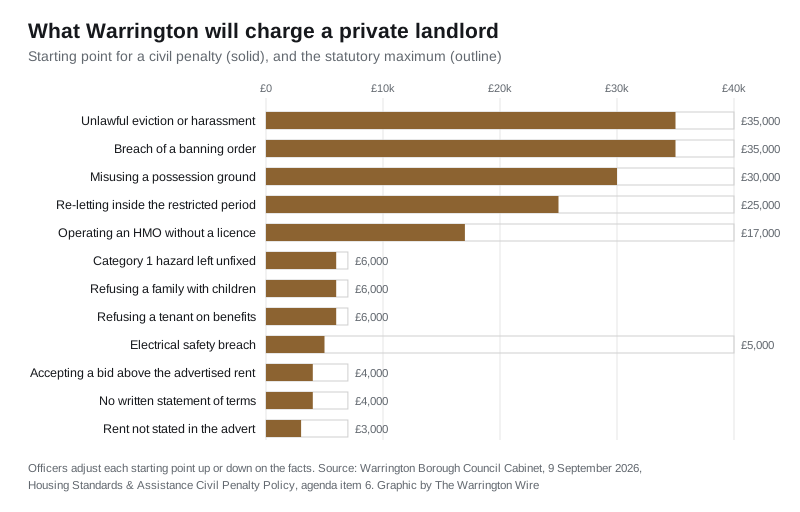
The policy sets a starting point for each breach, which officers then adjust up or down on the facts of the case. These are the starting points that matter most to a tenant:
| Breach or offence | Starting point | Maximum |
|---|---|---|
| Unlawful eviction or harassment of an occupier | £35,000 | £40,000 |
| Breach of a banning order | £35,000 | £40,000 |
| Misusing a possession ground so a tenant gives up the tenancy | £30,000 | £40,000 |
| Re-letting or re-marketing inside the restricted period after using Ground 1 or 1A | £25,000 | £40,000 |
| Operating an HMO without a licence | £17,000 | £40,000 |
| Failing to remove a category 1 hazard when it was reasonably practicable | £6,000 | £7,000 |
| Refusing to let to a family with children | £6,000 | £7,000 |
| Refusing to let to someone on benefits | £6,000 | £7,000 |
| Breaching the electrical safety regulations | £5,000 | £40,000 |
| Accepting an offer above the advertised rent | £4,000 | £7,000 |
| Not giving the tenant a written statement of terms | £4,000 | £7,000 |
| Not stating the proposed rent in the advert | £3,000 | £7,000 |
Two of those are worth pausing on, because they are new and because most tenants will not know they exist.
Rent bidding is now an offence. Under section 56 of the Renters’ Rights Act 2025, a landlord or agent must state the proposed rent in the advert, and must not invite, encourage or accept an offer above it. Warrington’s starting point is £3,000 for the first and £4,000 for the second.
Refusing a tenant because they claim benefits, or because they have children, is an offence in its own right, under sections 33 and 34 of the same Act. Warrington starts both at £6,000 against a £7,000 maximum.
Why now
The council’s report says civil penalties for these breaches came into force on 1 May 2026 through the Renters’ Rights Act 2025, and that the policy applies to any case where the council decided to start civil penalty proceedings on or after that date. The Secretary of State’s statutory guidance on civil penalties was published on 13 November 2025.
The report says the revised policies reflect “legislative and guidance changes since 2018”, which is how far back Warrington’s previous approach ran.
A civil penalty is not a court fine. The council issues a notice of intent, the landlord has a period to make written representations, and the council then decides whether to issue a final notice and for how much. No prosecution is involved, and the report notes that all penalty income must be reinvested directly into housing enforcement.
The discount, and the appeal
A landlord who pays in full within the payment period, normally 28 days, gets a 15% discount.
The report works the arithmetic through on an unlicensed HMO. The starting point is £17,000. After written representations the council settles on £16,000. Paid promptly, the landlord hands over £13,600.
A landlord can appeal to the First-tier Tribunal (Property Chamber) within 28 days of the final notice. The appeal is a full re-hearing, and the tribunal can confirm the penalty, reduce it, cancel it or increase it. Bringing an appeal suspends the final notice but does not extend the discount period.
The council says it will not generally agree to mediation on the level of a penalty, because agreeing reductions outside the policy would undermine consistency.
One number in the table does not add up
The schedule adjusts each starting point by a fifth in either direction depending on the landlord type. Applied to unlawful eviction, that produces a printed upward figure of £42,000, against a statutory maximum for the same offence of £40,000. The same happens at the other end of the scale, where several £7,000 maximum breaches print an upward-adjusted £7,200.
Elsewhere the policy is clear that a penalty cannot exceed the statutory maximum, and that the tribunal may increase one only up to that maximum. The document does not explain how the two are reconciled. We are flagging it rather than assuming which applies.
How many people this covers
At the 2021 census, 12,193 Warrington households rented from a private landlord or letting agency, with a further 1,580 in other private rented arrangements. Together that is 13,773 of the borough’s 90,538 households, just over one in seven.
For comparison, 13,842 households rented from the council or another social landlord, and 62,185 owned their home outright or with a mortgage.
What it means for you
If you rent privately in Warrington. The council does not only act on complaints. Its officers also inspect through licensing and take referrals from other public bodies. But a complaint or request for assistance is one of the three routes named in the policy, so reporting a problem does start a process.
If your home has damp, mould or another serious hazard. The council has a duty under section 5 of the Housing Act 2004 to take formal enforcement action where a category 1 hazard exists, and a discretionary duty where a significant category 2 hazard does. A landlord who could reasonably have fixed a category 1 hazard and did not now faces a penalty starting at £6,000.
If you have been threatened with eviction outside the proper process. The policy says the council will usually take formal action in the first instance, rather than an informal warning, for unlawful eviction or harassment, for HMO licensing offences, and where there has been non-compliance before.
If you are a landlord. The report is explicit that the council expects landlords to have a good understanding of the standards required. Fixing the problem after a notice of intent will rarely stop a penalty, though it is usually treated as mitigation that reduces the amount.
What we could not confirm
Warrington’s Cabinet minutes for 9 September had not been published when we checked on 21 September, so the formal record of the vote is not yet online. The report before Cabinet recommended approval, and the council’s own 16 September statement describes the policies as the framework it will now use. The report asked for the policies to come into force on 1 July 2026, a date that had already passed when Cabinet considered them, although the penalty policy separately states that it applies to proceedings started on or after 1 May 2026.
We will report the minutes when they appear.
Sources
- Warrington Borough Council Cabinet, 9 September 2026, agenda item 6: Housing Standards & Assistance Team Enforcement Policy & Housing Standards & Assistance Civil Penalty Policy, key decision 016/26. Agenda document pack
- Warrington Borough Council, New powers to improve rented homes in Warrington, 16 September 2026
- Renters’ Rights Act 2025
- Office for National Statistics, Census 2021 tenure of household, Warrington, via Nomis
Related: our guides to council tax bands and planning applications in Warrington.
Have your say